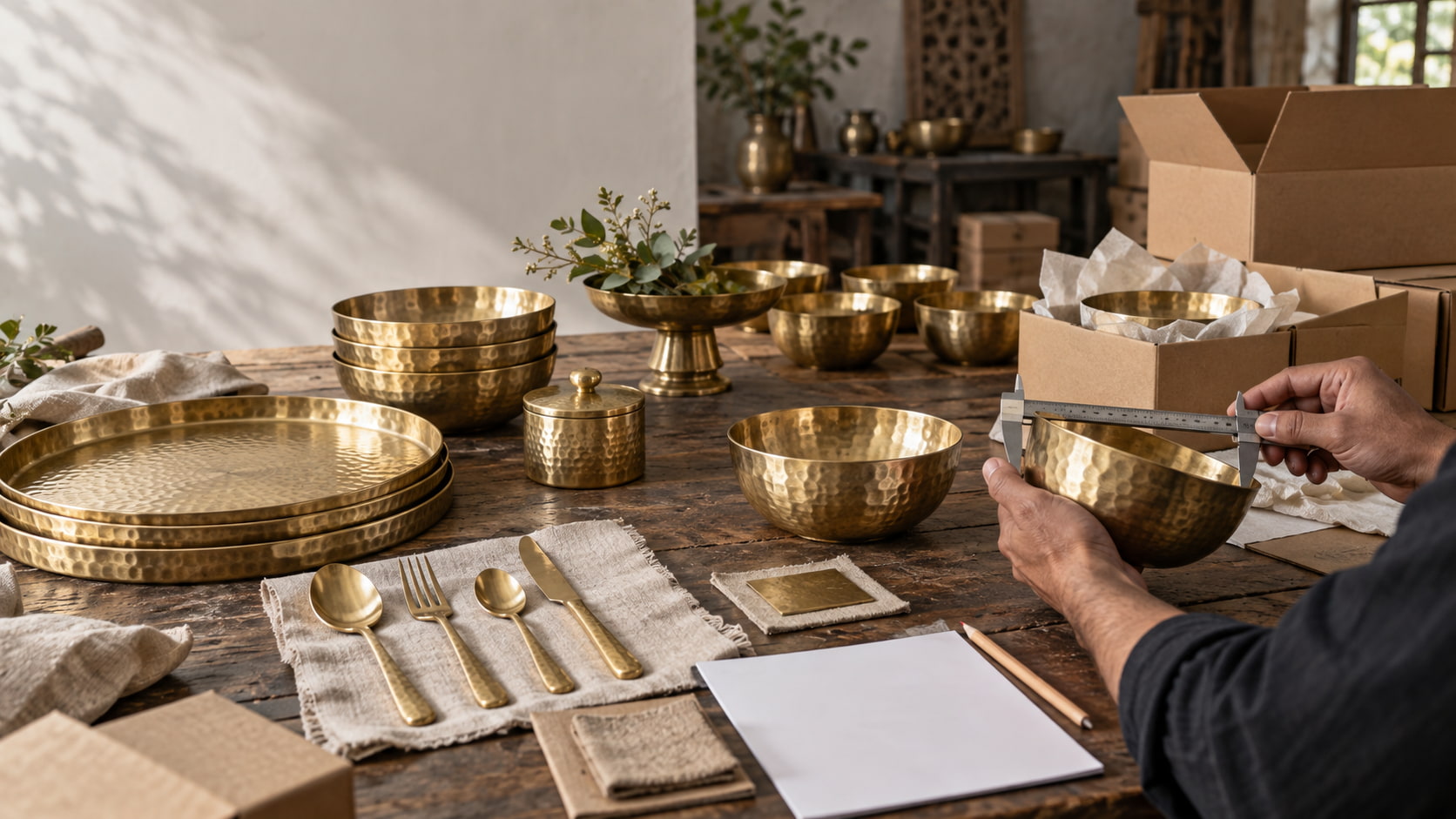

 Trade & Sourcing
A brass bowl can look beautiful in a photograph and still be wrong for a wholesale order.
Perhaps the alloy is not clearly specified.
Perhaps the finish changes too much from one production batch to another.
Perhaps the dimensions make the pieces expensive to ship.
Perhaps a serving piece intended for food contact has not been evaluated for the buyer’s market.
Or perhaps the first 20 pieces are excellent, but nobody has agreed what quality standard the next 500 should meet.
That is why sourcing wholesale brass tableware requires more than comparing photographs and unit prices.
For retailers, hospitality groups, importers, distributors and design-led brands, the important questions begin with the product itself and continue through sampling, material specification, finish, quantity, packaging, inspection, trade terms and future reorders.
India is already a substantial source of handcrafted metalware for international markets. The Export Promotion Council for Handicrafts reports ₹4,349.83 crore of art-metalware exports in 2025–26, including significant exports to markets such as the United States, Germany, United Kingdom, UAE and Netherlands.
The opportunity is established.
The buyer’s job is to make the order specific enough to succeed.
What Is Wholesale Brass Tableware?
Wholesale brass tableware generally refers to brass objects purchased in trade quantities for resale, hospitality use, gifting, projects or distribution rather than as individual consumer purchases.
Depending on the collection, this can include:
- Bowls
- Serving trays
- Plates
- Cups
- Cutlery
- Serving utensils
- Containers
- Platters
- Napkin accessories
- Tabletop objects
- Centrepieces
- Barware
- Decorative serveware
The term wholesale, however, tells you very little about how the product has actually been made.
Two suppliers may both offer a “brass serving tray” while supplying objects with different:
- Alloy compositions
- Weights
- Thicknesses
- Surface treatments
- Construction methods
- Finishes
- Linings
- Packaging standards
- Levels of handwork
The first rule of bulk buying is therefore simple:
Buy the specification, not the product name.
1. Confirm What the Product Is Actually Made From
“Brass colour” and “solid brass” are not the same thing.
A gold-toned tableware product could potentially be:
- Solid brass
- Brass-plated metal
- Stainless steel with a brass-coloured finish
- Aluminium with a decorative finish
- Iron with a gold-toned coating
Those constructions can differ considerably in weight, ageing, care requirements and price.
Before requesting a final quotation, ask:
- What is the base material?
- Is the item solid brass or plated?
- What alloy or material specification is used?
- Is the product cast, sheet formed or made by another method?
- Is there an interior lining?
- Is there a lacquer or protective coating?
- Are different metals used in handles, feet or fittings?
This matters even more when products are intended for food service.
A photograph cannot answer these questions.
A specification can.
2. Do Not Treat All Brass as One Identical Material
Brass is a family of copper-based alloys rather than one fixed composition.
Different brass grades can contain different proportions of copper, zinc and, depending on the alloy, other elements.
That means a bulk order described simply as:
“500 brass bowls”
may not define the material precisely enough when composition affects the intended application.
For decorative tableware, an exact engineering-grade specification may not always be necessary.
For regulated or food-contact applications, however, buyers should establish exactly what material and construction are being supplied.
The broader lesson is:
Colour is not a material specification.
3. Decide Whether the Product Is Decorative or Intended for Food
This should be established near the beginning of the sourcing process.
A decorative brass centrepiece does not have the same requirements as a bowl intended to hold food.
Neither does a tray used beneath wrapped products necessarily have the same requirements as a vessel that directly contacts food.
Separate the collection into clear use categories:
Decorative
Objects not intended for direct food contact.
Serving
Pieces intended to participate in food or beverage service.
Direct Food Contact
Surfaces intended to touch food directly.
Drinkware
Vessels intended to hold beverages.
The distinction affects materials, linings, coatings, care instructions and compliance requirements.
4. Check Food-Contact Requirements for the Destination Market
Do not assume that because a product is traditionally used for food in one country, it automatically satisfies the commercial requirements of another.
Regulations vary.
European Union
The European Commission defines tableware and kitchenware intended to contact food as Food Contact Materials.
Materials placed on the EU market must comply with the general requirements of Regulation (EC) No 1935/2004, including principles intended to prevent unsafe migration of constituents into food and unacceptable changes to food composition, taste or odour. Good Manufacturing Practice requirements also apply, while additional material-specific or national rules may be relevant.
United States
The FDA Food Code provides a useful example of why buyers need to consider the exact intended use.
It states that copper and copper alloys such as brass generally may not contact food below pH 6, including examples such as vinegar, fruit juice or wine, subject to specified exceptions.
The practical question is therefore not:
“Is brass food safe?”
It is:
“Is this exact product, alloy, lining, finish and construction appropriate for the intended food-contact use and destination market?”
That is a much better procurement question.
5. Understand Linings and Interior Surfaces
Some brass tableware intended for food use may include an interior lining or other treatment.
If a product is lined, ask:
- What is the lining material?
- Where is it applied?
- Is the entire food-contact surface covered?
- How is it maintained?
- Can it wear through?
- Can it be repaired or renewed?
- What care instructions apply?
- What supporting documentation is available if required?
Lume Loam’s current published terms, for example, state that table-use pieces intended for food contact are tin-lined and that individual product pages distinguish food-use pieces from decorative items. Its terms also note that the tin lining can wear over time and may require re-tinning.
For a wholesale buyer, this reinforces why the exact construction of each SKU needs to be documented rather than assuming one rule applies to an entire catalogue.
6. Define the Finish Before Asking for Bulk Pricing
“Antique brass” is not a precise enough instruction by itself.
Neither is:
- Golden brass
- Matte brass
- Vintage brass
- Old brass
- Brushed brass
Two suppliers may interpret those terms differently.
Even two production teams within the same workshop may produce different results unless there is an approved reference.
Before bulk production, establish:
- Bright or muted?
- Polished or satin?
- Smooth or hammered?
- Light antique or dark antique?
- Uniform or deliberately varied?
- Lacquered or unlacquered?
- Natural ageing expected or restricted?
If colour is important, approve a physical reference whenever practical.
Screen photographs are useful, but metal reacts strongly to:
- Light direction
- Camera exposure
- White balance
- Screen brightness
- Surrounding colours
A finish that looks dark bronze on one monitor can appear yellow-gold on another.
7. Ask How the Finish Will Change With Time
Brass is not necessarily visually static.
Its surface can change through handling, oxidation, moisture and environmental exposure.
Lume Loam’s current published terms explicitly note that brass, copper and bronze can naturally develop patina over time and that handmade pieces may show variations in colour, surface grain and finish sheen.
Before placing a wholesale order, ask:
- Is the brass sealed?
- Is there lacquer?
- Is the finish intended to age?
- Will fingerprints show?
- Is occasional polishing recommended?
- Will polishing remove an antique treatment?
- How should the product be stored?
- How should the customer care for it?
This information belongs in the buying decision.
It may also belong on your retail care card.
8. Approve a Physical Sample
When the order size justifies it, do not move directly from website photography to bulk production.
Request or develop a sample.
Check it physically.
Look At
- Colour
- Finish
- Hammer pattern
- Shape
- Edge quality
- Engraving
- Surface consistency
Measure
- Diameter
- Height
- Depth
- Capacity
- Handle position
- Base dimensions
Feel
- Weight
- Balance
- Surface texture
- Edge comfort
- Handle comfort
Test
- Stability
- Nesting
- Stacking
- Intended food or service function
- Packaging
- Storage
A wholesale sample is not simply a miniature purchase.
It is the reference for the production order.
9. Turn the Approved Sample Into a Written Specification
Do not rely on the sample alone.
People change.
Production teams change.
Months pass.
Reorders happen.
Write the key details down.
A simple specification sheet could look like this:
| Requirement | Example |
| Product | Hand-hammered serving bowl |
| Material | Agreed brass specification |
| Diameter | Final approved dimension |
| Height | Final approved dimension |
| Weight | Target / agreed tolerance |
| Surface | Hand-hammered |
| Finish | Approved antique-brass sample |
| Interior | Agreed lining or surface |
| Logo | Underside, centred |
| Packaging | Individual protective wrap |
| Master Carton | Agreed units per carton |
| Use | Decorative / serving / food contact |
| Quality Reference | Approved production sample |
Use whatever fields matter to your product.
The objective is to remove assumptions before manufacturing starts.
10. Define Acceptable Handmade Variation
Wholesale buyers often face two opposite mistakes.
The first is expecting handcrafted objects to be visually identical.
The second is accepting almost any inconsistency because the product is handmade.
Neither approach is useful.
Hand hammering and hand finishing naturally create variation.
Lume Loam’s current terms state that its hand-hammered, cast, sculpted and hand-finished products can differ slightly in hammer pattern, depth, surface grain, colour, finish sheen and minor dimensions.
That kind of character may be exactly why the buyer selected handcrafted metalware.
But you can still require:
- Stable bases
- Smooth edges
- Correct capacity
- Defined dimensional range
- Secure handles
- Consistent logo placement
- Suitable lining
- Correct carton count
A useful rule is:
Allow variation in the handwork. Control variation that affects function.
11. Understand MOQ Properly
One of the first questions wholesale buyers ask is:
“What is your MOQ?”
But minimum order quantity is rarely meaningful without context.
MOQ can depend on:
- Existing versus custom design
- Size
- Material
- Finish
- Tooling
- Engraving
- Packaging
- Number of SKUs
- Number of finishes
- Production method
Ask whether the MOQ applies:
- Per SKU
- Per size
- Per finish
- Per colour
- Per design
- Per total order
Consider this difference:
300 pieces of one brass bowl
is not necessarily equivalent to:
300 pieces split across 15 designs, three finishes and five sizes.
Both total 300 pieces.
The production complexity is completely different.
12. Avoid Too Many SKUs in the First Order
A common buying mistake is trying to build an entire collection immediately.
For example:
- 8 bowl shapes
- 5 tray designs
- 4 cutlery sets
- 3 containers
- 4 finishes
- 2 sizes of everything
The collection becomes complicated before the buyer has learned which items customers actually want.
For a first wholesale order, consider concentrating quantity around a smaller number of stronger products.
This can make it easier to:
- Evaluate quality
- Manage samples
- Consolidate quantities
- Control finish
- Simplify packaging
- Test customer response
- Learn reorder behaviour
Scale the assortment once there is evidence to support it.
13. Check Dimensions Carefully
Small dimensional changes can have large commercial consequences.
A tray that increases from 30 cm to 34 cm may affect:
- Carton dimensions
- Pieces per carton
- Shipping volume
- Shelf space
- Display
- Packaging cost
A bowl that does not nest efficiently can require far more freight volume than one designed to stack.
Never estimate size from a photograph.
Request written dimensions.
For nesting products, ask for:
- Individual dimensions
- Nested stack height
- Pieces per stack
- Carton dimensions
These details make landed-cost calculations much more useful.
14. Check Weight
Weight affects more than how premium the item feels.
It also affects:
- Freight
- Packaging
- Handling
- Shelving
- Hospitality operations
- Customer expectations
Ask for:
- Approximate unit weight
- Net carton weight
- Gross carton weight
For handcrafted products, a reasonable weight tolerance may need to be agreed rather than expecting every unit to weigh exactly the same.
15. Understand the Complete Price
Do not compare wholesale quotations based only on the number next to “unit price”.
Ask what the quotation includes.
Potential cost components can include:
**Product
- sample development
- tooling
- engraving
- branding
- individual packaging
- master cartons
- inspection
- inland transport
- export handling
- freight
- insurance
- customs clearance
- duty
- local tax
- final delivery**
Some items will apply to one order and not another.
The important point is that the buyer compares like with like.
A supplier quoting $12 under one trade term cannot necessarily be compared directly with a supplier quoting $14 under another.
16. Confirm the Currency
It sounds obvious, but commercial documentation should state the transaction currency clearly.
For example:
- USD
- GBP
- EUR
- INR
- AED
Also establish:
- Whether pricing is fixed
- How long the quotation remains valid
- Whether metal-price movements can affect later orders
- Whether development charges are separate
- Whether prices change at higher quantities
Do not rely on assumptions made during informal messaging.
17. Understand Payment Terms Before Production
Payment terms should be agreed before the order enters production.
Depending on the transaction, the commercial arrangement may involve:
- Advance payment
- Deposit plus balance
- Letter of credit
- Other mutually agreed structures
The correct arrangement depends on:
- Order value
- Supplier relationship
- Buyer policy
- Country
- Banking requirements
- Risk allocation
For a first order, clarity matters more than complexity.
Write down:
- Amount due
- Currency
- Payment milestone
- Balance trigger
- Bank charges where relevant
- Documentation required before final payment if applicable
18. Confirm What the Price Means for Shipping
International wholesale orders need an agreed delivery term.
ICC’s Incoterms® 2020 contains 11 standard trade rules used in B2B goods contracts to clarify responsibilities relating to delivery, costs and risk.
The difference can be substantial.
Under one arrangement, the buyer may take responsibility much earlier in the journey.
Under another, the seller may arrange carriage further towards the destination.
Do not accept:
“Shipping extra.”
Ask for:
Incoterm + named place/port + Incoterms® 2020
For example, the named place matters because Incoterms rules use it to help determine delivery and risk-transfer responsibilities.
19. Do Not Assume FOB Is Always the Right Term
FOB is widely recognised, but it should not automatically be used for every shipment.
ICC distinguishes terms intended specifically for sea/inland waterway transport from those available for any mode or combination of modes.
The correct trade term depends on:
- Transport mode
- Containerisation
- Freight arrangement
- Delivery point
- Who controls shipping
- Buyer and seller capabilities
The buyer does not need to become a freight expert.
But the quotation should make clear which rule applies and where.
20. Review Packaging Before Production Is Complete
Brass may be metal, but a finished brass surface is not indestructible.
Products can:
- Scratch
- Rub
- Dent
- Tarnish
- Move inside cartons
Packaging must protect both shape and finish.
Ask how each unit will be packed.
Possible elements include:
- Tissue
- Protective sleeves
- Non-abrasive separators
- Inner cartons
- Individual boxes
- Master cartons
- Moisture protection where appropriate
- Edge protection
The correct solution depends on the product.
A large brass tray requires different protection from a four-piece cutlery set.
21. Ask for the Master Carton Specification
For a bulk buyer, the master carton is almost as important as the retail box.
Request:
- Carton length
- Width
- Height
- Units per carton
- Net weight
- Gross weight
- Carton numbering
- Shipping marks
This allows your freight forwarder to calculate transportation more accurately.
It also helps warehouse teams prepare for arrival.
22. Think About Container and Freight Efficiency
Freight cost is not determined only by product price.
For many shipments, volume matters considerably.
Consider whether products:
- Nest
- Stack
- Require large amounts of void space
- Need individual rigid boxes
- Can share carton sizes
- Create inefficient master cartons
A beautifully designed bowl that nests may be commercially easier to ship than a sculptural object with the same retail value but four times the cubic volume.
This does not mean every product needs to become compact.
It means logistics should be understood before the final purchase order.
23. Agree How Quality Will Be Inspected
Inspection criteria should be determined before finished goods are packed.
For wholesale brass tableware, checks may cover:
Material
Does the product match the approved material specification?
Dimensions
Are critical measurements within the agreed range?
Finish
Does the colour and surface character fall within the approved reference?
Workmanship
Are edges, joints and handles appropriately finished?
Function
Does the product sit, stack, hold or serve correctly?
Lining
Where specified, is the food-contact lining correctly applied?
Branding
Is the logo positioned correctly?
Quantity
Is the correct number of pieces present?
Packaging
Are surfaces protected?
You do not need to measure every characteristic of every piece.
But you do need to decide what matters.
24. Do Not Inspect Only From the Top
A wholesale product may look perfect in a staged photograph while having problems underneath.
Inspect:
- Base
- Feet
- Underside
- Handles
- Joins
- Rim
- Interior
- Engraving
- Lining
- Contact points between stacked pieces
For trays and bowls, stability is particularly important.
Place the sample and production units on a flat surface.
A product that rocks noticeably may create a poor customer experience even if the finish looks beautiful.
25. Test Packaging With the Product Inside
A cardboard box can look strong while empty and fail once loaded.
Where order value justifies it, packaging review can include:
- Product fit
- Movement inside the box
- Surface contact
- Stacking pressure
- Carton handling
- Drop or transport testing where appropriate
The objective is not to make packaging excessively heavy.
It is to make it sufficient.
26. Confirm Export Documentation
For exports from India, DGFT identifies core documentation for goods including:
- Bill of lading, airway bill or other applicable transport receipt
- Commercial invoice-cum-packing list
- Shipping bill or bill of export
Additional documentation can apply to specific goods, regulated categories or destination requirements.
Depending on the shipment, buyers may also encounter:
- Certificate of origin
- Testing documentation
- Insurance documents
- Buyer-specific declarations
- Destination-specific documents
Do not ask:
“Which certificates come with brass?”
Ask:
“Which documents are required for this product, this HS classification, this use and this destination?”
27. Clarify Country-of-Origin and Labelling Requirements
International buyers should confirm what labelling their destination market requires.
This can involve:
- Country of origin
- Importer details
- Product identification
- Material information
- Care instructions
- Food-contact information
- Barcode
- Carton marks
Requirements vary.
Do not print thousands of labels before the importer or responsible compliance team has approved them.
28. Discuss Barcode and Retail Packaging Early
If the order is for retail, the supplier may need information about:
- EAN / UPC / other barcode
- SKU
- Product title
- Variant
- Pack quantity
- Care card
- Brand mark
- Country-of-origin statement
- Retail box dimensions
- Price sticker area
Give final approved artwork.
Do not send low-resolution screenshots and expect production-ready packaging.
29. Clarify Private-Label Requirements
If the collection will carry your own brand, define what private labelling actually means.
It could involve:
- Engraved logo
- Stamped logo
- Hang tag
- Sticker
- Printed box
- Care card
- Branded sleeve
- Custom carton
- Barcode labelling
Do not assume the supplier interprets “private label” in the same way you do.
Spell out each requirement.
30. Plan Production Around the Real Delivery Date
A statement such as:
“Production takes four weeks”
does not mean your goods will arrive in four weeks.
The full timeline can include:
Sampling → Approval → Material procurement → Production → Finishing → Inspection → Packing → Export clearance → Freight → Import clearance → Final delivery
Work backwards from:
- Store launch
- Hotel opening
- Seasonal campaign
- Trade show
- Holiday period
- Corporate-gifting date
Build margin into the schedule.
Missing an important retail season can cost much more than paying slightly more per unit.
31. Start With a Controlled First Order
A large first order can deliver scale.
It can also magnify every misunderstanding.
A controlled initial order lets you learn:
- How accurate samples are
- How consistent production is
- How the finish behaves
- Whether packaging works
- How customers respond
- How fast products sell
- Whether reorders are practical
- How communication works during production
Once those answers are clear, scaling becomes more informed.
32. Plan for Reorders Before the First Order Ships
One of the most important wholesale questions is:
Can I buy this again?
Ask:
- Will the material remain available?
- Can the finish be reproduced?
- Is there a reorder MOQ?
- Will the same tooling be retained?
- Can the supplier retain the specification?
- How much variation could occur between production batches?
- Are replacement pieces possible?
Keep:
- Approved sample
- Specification sheet
- Final photographs
- Purchase order
- Finish reference
- Packaging artwork
- Product codes
A good reorder should not require rebuilding the product from memory.
33. Do Not Depend on Product Photography for Reorders
Metal is especially difficult to colour-match through photographs.
If finish continuity matters, keep the actual approved sample wherever possible.
Photography can support the record.
It should not necessarily replace the physical reference.
This is particularly useful for:
- Antique brass
- Patinated finishes
- Hand-hammered surfaces
- Mixed polished/matte finishes
34. Ask What Happens if Products Fail Inspection
Before production begins, agree how quality issues will be handled.
Possible scenarios include:
- Rework
- Refinishing
- Replacement
- Quantity adjustment
- Other agreed commercial resolution
The appropriate approach depends on the defect.
A small variation in hammer texture is not the same as:
- Wrong dimensions
- Broken handle
- Sharp edge
- Incorrect logo
- Missing lining
- Wrong material
Classify quality requirements before problems happen.
35. Compare Suppliers on More Than Price
When evaluating wholesale brass tableware suppliers, compare:
| Area | What to Evaluate |
| Product | Does the range suit your market? |
| Material | Is construction clearly specified? |
| Sample | Does it match the brief? |
| Finish | Can the desired appearance be repeated? |
| Communication | Are answers clear and specific? |
| MOQ | Does it fit your assortment strategy? |
| Packaging | Is the product protected efficiently? |
| QC | Is there an agreed inspection standard? |
| Export | Are international orders understood? |
| Documentation | Can required documents be coordinated? |
| Reorders | Can successful products be reproduced? |
| Price | Does the landed economics make sense? |
The cheapest supplier is not automatically the least expensive supplier.
Damage, inconsistent batches, unusable packaging and missed delivery windows all cost money too.
Wholesale Brass Tableware Buyer Checklist
Before approving your bulk order, confirm:
Product
- Exact product approved
- Base material confirmed
- Solid / plated construction confirmed
- Dimensions confirmed
- Capacity confirmed where applicable
- Approximate weight confirmed
- Finish approved
- Lining/coating confirmed
- Intended use confirmed
Sample
- Physical sample reviewed
- Finish approved
- Dimensions measured
- Function tested
- Packaging reviewed
- Approved reference retained
Quantity
- MOQ understood
- MOQ per SKU clarified
- Quantity per design agreed
- Quantity per finish agreed
- Reorder MOQ discussed
Commercial Terms
- Unit price confirmed
- Currency confirmed
- Quote validity confirmed
- Development/tooling charges identified
- Payment terms agreed
- Incoterm agreed
- Named place/port stated
Compliance
- Destination country identified
- Intended food-contact use identified
- Applicable requirements reviewed
- Testing requirements agreed
- Labelling reviewed
- Buyer-specific documents identified
Quality
- Critical tolerances documented
- Handmade variation defined
- Inspection method agreed
- Branding position approved
- Defect-resolution process agreed
Packaging
- Individual protection approved
- Retail packaging approved
- Master carton agreed
- Units per carton confirmed
- Carton dimensions confirmed
- Net/gross weight confirmed
- Shipping marks approved
Delivery
- Production schedule agreed
- QC time allowed
- Export time allowed
- Freight time considered
- Import clearance considered
- Required final-delivery date documented
Common Mistakes When Buying Brass Tableware Wholesale
Choosing From Appearance Alone
A photograph does not tell you the alloy, weight, lining, construction or long-term finish behaviour.
Better: approve specifications and samples.
Asking Only for the Lowest Price
A cheaper unit may have weaker packaging, less finish control or higher freight volume.
Better: compare total commercial value.
Assuming Brass Means Solid Brass
Colour does not prove construction.
Better: ask what the base material actually is.
Using “Antique Brass” as the Entire Finish Specification
The term is subjective.
Better: approve a reference sample.
Ignoring Carton Size
Freight can alter landed economics dramatically.
Better: request packing dimensions before the order is complete.
Ordering Too Many SKUs
Small quantities spread across too many variants can increase complexity.
Better: concentrate the first range.
Forgetting Food-Contact Requirements
A beautiful bowl is not automatically suitable for every food or market.
Better: confirm construction and destination requirements early.
Treating Handmade as Identical
Some visual variation is natural.
Better: define acceptable tolerances.
Treating Handmade as Uncontrolled
Craft variation is not an excuse for unstable bases, sharp edges or wrong dimensions.
Better: establish measurable quality requirements.
Forgetting Reorders
Successful products need continuity.
Better: document the approved specification from the start.
Wholesale Brass Tableware From India
India offers international buyers access to a large and established art-metalware supply base.
EPCH reports Indian art-metalware exports of ₹4,349.83 crore in 2025–26, following ₹4,386.63 crore in 2024–25. The United States remained the largest named destination in its current country data, followed by substantial trade with markets including Germany, the U.K., UAE and Netherlands.
Those figures demonstrate an existing global market.
But they do not guarantee that every supplier, product or order will suit every buyer.
Successful sourcing still depends on the basics:
A clear product.
A clear specification.
A clear quality standard.
A clear commercial agreement.
Buying Brass Tableware From Lume Loam
Lume Loam’s current collection includes multiple brass table and home objects, including Brass Serving Tray, Brass Art Deco Tray, Brass Cutlery 4 Pieces Set, Brass Bowl Round Set, Brass Container and handcrafted brass centrepieces.
Its published terms also explain that its objects are hand-finished and that variations in hammer patterns, surface grain, slight colour, finish sheen and minor dimensions can be part of the handmade character.
For a trade enquiry, however, commercial details such as wholesale MOQ, available finishes, quantity, lead time, customisation, testing requirements, export terms and packaging should be confirmed against the specific order rather than inferred from retail listings.
A useful first enquiry should include:
- Product or category
- Approximate quantity
- Destination country
- Intended use
- Required dimensions
- Preferred finish
- Food-contact requirement, if any
- Branding or private-label needs
- Packaging requirements
- Required delivery date
The more clearly the order is described, the more useful the quotation can be.
Final Thought: Buy for the Second Order
The first bulk order receives most of the attention.
But a good wholesale product should also survive the question:
What happens when we need another 500?
Can the finish be repeated?
Can the same dimensions be maintained?
Can the packaging be reproduced?
Can the supplier identify the old specification?
Can you explain the material and care to your customer?
Can the product still make sense after freight, duty and storage?
That is the difference between buying a batch of attractive objects and building a collection.
When sourcing wholesale brass tableware, do not evaluate only what arrives in the first carton.
Evaluate whether the product, specification and supplier relationship are strong enough to make the next carton easier.
Frequently Asked Questions
What should I check before buying brass tableware wholesale?
Confirm the base material, solid or plated construction, dimensions, weight, finish, lining or coating, intended use, MOQ, sample, packaging, quality tolerances, food-contact requirements, pricing terms and shipping responsibilities before approving the bulk order.
Is all gold-coloured tableware made from brass?
No. A gold-toned product may be brass, brass plated or another metal with a decorative finish. Ask the supplier to specify the actual base material and construction.
Should I request a sample before ordering wholesale brass tableware?
Yes, particularly for a new product, supplier or finish. A physical sample helps you assess weight, dimensions, balance, surface quality, colour, functionality, packaging and overall workmanship.
Is brass suitable for food-contact tableware?
It depends on the exact construction, alloy, lining, intended food and applicable regulations. For example, the FDA Food Code restricts direct contact between copper or copper alloys such as brass and foods below pH 6 in covered food-service applications, subject to specified exceptions.
What MOQ should I expect for brass tableware?
There is no universal MOQ. It can depend on the design, quantity per SKU, finish, tooling, packaging and level of customisation. Ask whether the quoted MOQ applies per product, size, finish or total order.
Does handmade brass tableware vary from piece to piece?
Yes. Hand hammering and finishing can create small differences in surface pattern, texture, colour or dimensions. The buyer should still define tolerances for characteristics that affect function or commercial quality.
What is the difference between solid brass and brass-plated tableware?
Solid-brass products use brass as the primary body material. Brass-plated products use a different base material with a brass layer or finish over it. The two can differ in weight, wear, ageing, care and price.
What trade term should I use when importing brass tableware?
The appropriate term depends on the mode of transport and commercial arrangement. ICC’s Incoterms® 2020 contains 11 rules covering different allocations of delivery responsibility, cost and risk. Buyers and sellers should use the appropriate rule together with a clearly named place or port.
What export documents are normally used when brass tableware is shipped from India?
DGFT identifies a transport document, commercial invoice-cum-packing list, and shipping bill or bill of export among the core documents for export of goods from India. Additional documents may apply depending on the product and destination.
Can brass tableware develop patina?
Yes. Unprotected brass can gradually change surface tone through interaction with air, moisture and handling. Coatings and finish treatments can affect how quickly or visibly this happens. Buyers should establish expected finish behaviour and care instructions before ordering.